
Jewish history, literature, and philosophy have never been static fields. Questions that seemed settled get reopened. Texts long overlooked turn out to hold answers to questions that scholars are only now learning to ask.
The PhD in Jewish Studies puts you at the center of this ongoing conversation, poised to break new ground.
“We encourage talented students who are drawn to research, and who want to contribute creatively and productively to the world’s knowledge of Jewish history and Jewish thought, to pursue the PhD.”
- Dr. Moshe Sokol, Dean, Graduate School of Jewish Studies
A Close-Knit Community of Inquiry
GSJS' PhD program is selective by design, allowing you to grow as a scholar with the support of like-minded peers and professors.
Academic careers in Jewish Studies are rare and competitive — we won’t pretend otherwise. Our PhD graduates have gone on to teach at universities and Jewish day schools, to lead Jewish religious and cultural institutions, and to contribute scholarship that shapes our understanding of Jewish identity today.
Faculty Spotlight: Dr. Sid Leiman, Distinguished Professor of Jewish History and Literature
Dr. Sid Leiman has been passionate about Jewish studies since before it was a recognized academic field. He started graduate school at the University of Pennsylvania in 1965, when the discipline barely existed, and later taught at top universities in the U.S. and Israel, including Yale, Harvard, Columbia, and Hebrew University.
In his GSJS seminars, Dr. Leiman encourages students to read critically, question received wisdom, and locate primary sources others have missed. “We’re interested in truth, accuracy, and translating new discoveries in a way that benefits everyone,” he says.
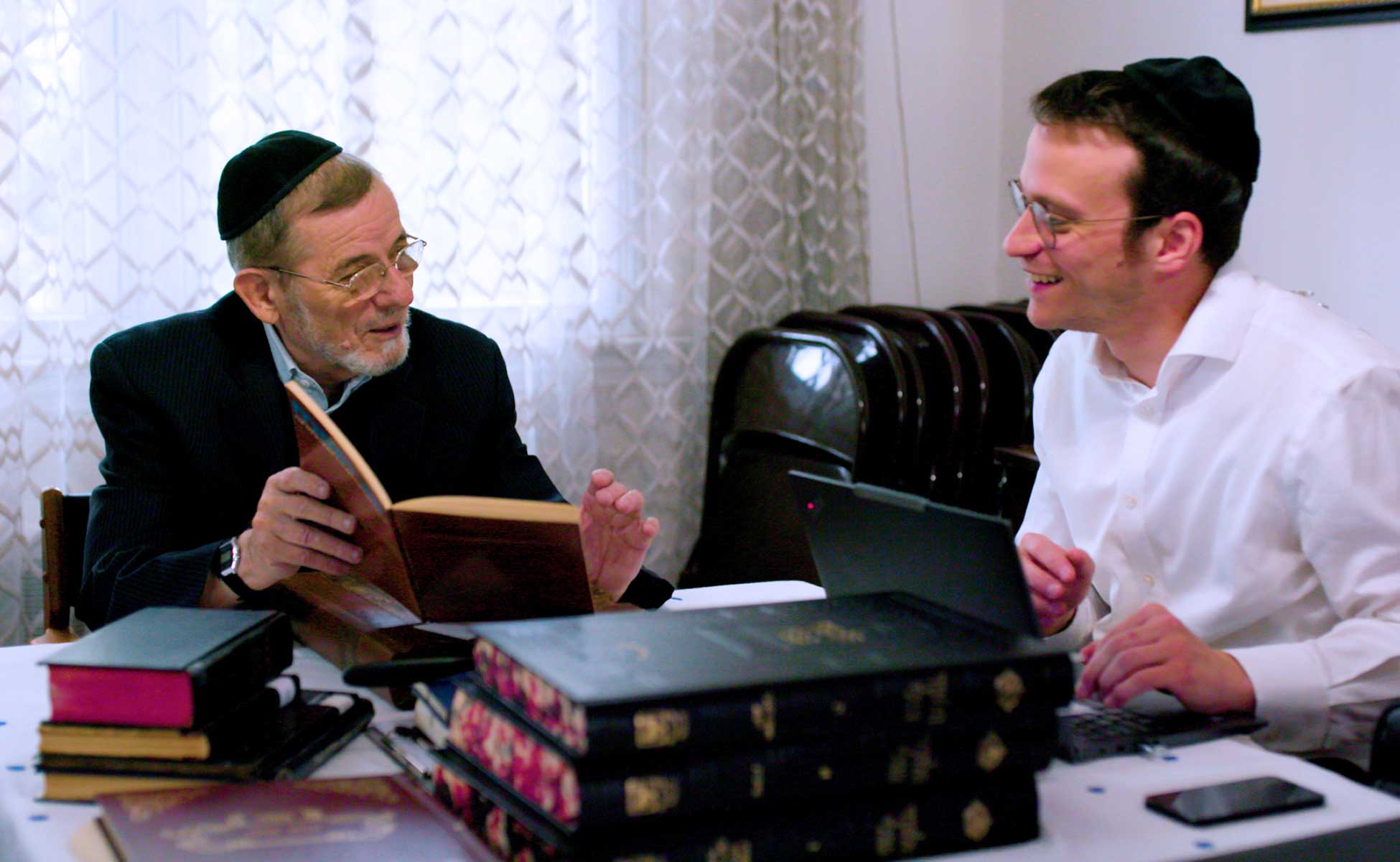
When students reach the advanced stages of their dissertations, Dr. Leiman hosts weekly one on one advising sessions, often at his home in Queens. Surrounded by his personal library of 30,000 volumes, he may be inspired to lend a text that opens up a new mode of analysis or reframes a student’s argument.
“I haven’t read all 30,000 books. I’m still working on it,” he says wryly. “Maybe the day I finish the last one, I’ll retire.”
Your Academic Journey: From Coursework to Dissertation Defense
Earning a PhD typically takes five to seven years. You'll work in small cohorts with faculty mentors who actively publish and present their findings.
As your own research takes shape, you'll explore primary and secondary sources across more than a millennium of Jewish intellectual and cultural history, from medieval texts to modern thought.
Here’s what the PhD path looks like:
- Complete doctoral seminars to build your breadth of knowledge across medieval and modern Jewish history and thought.
- Pursue focused coursework in your area of specialization.
- Demonstrate reading proficiency in Hebrew and other languages relevant to your research.
- Sit for written and oral comprehensive examinations in a major and minor area of specialization.
- Develop and defend a 30–70 page dissertation proposal for your original contribution to the field.
- Write your dissertation chapter by chapter, with close feedback from a committee of faculty members.
- Submit, revise, and defend your dissertation.
Original Research Spotlight: Select GSJS Dissertations
Each dissertation produced since the PhD program launched in 2018 represents years of original research, sustained inquiry, and close mentorship.
Together, these projects demonstrate the breadth of questions GSJS doctoral candidates bring to Jewish history, thought, and culture. Examples include:
- Gentile Foods: Rabbinic Prohibitions and the Fear of Intermarriage, David Raab
- Jews in Chmielnik, 1556–1946: The Rise and Fall of a Polish Jewish Community, Rivka Chaya Schiller
- "R. Israel Lipschutz and the Tiferet Yisrael: A Mishnah Commentary in the Modern Age," Sarah Cohen
Alumni Spotlight: Rivka Schiller, 2023 PhD Graduate
When Rivka Schiller joined the first Ph.D. cohort at GSJS, she brought with her a rare combination of linguistic fluency, personal motivation, and historical intuition.
As a professional translator of Yiddish, she helps filmmakers, TV producers, and others unlock historical and genealogical records that would otherwise remain inaccessible. "Much of the Yiddish I encounter is written on a very colloquial level," she says. "For me, translation involves decoding."
Rivka's connection to the language runs deep. She grew up in a Yiddish-speaking family with Polish grandparents who survived the Holocaust. That early immersion shaped her awareness of nuance and her desire to preserve cultural memory.
Her dissertation drew on sources most scholars couldn't access, examining how Jews in Chmielnik, Poland, lived, learned, and built communal life for nearly four centuries until the Holocaust destroyed their village.
In the doctoral program, Rivka found that her translation work and her research informed each other. Reading historical documents in Yiddish sharpened her sensitivity as a translator, while translating kept her attuned to gaps in the historical record.
"To a great degree, it was a spoken language, more so than a written one," she says. "I have to get a feel for the patterns and idiosyncrasies before I can render it eloquently in English."
Ready to Join Our Academic Community?
The admissions committee is looking for students who arrive with a clear research focus and the preparation to pursue it seriously. A strong application includes:
- BA or MA in a related field, with outstanding research papers.
- A research focus aligned with the expertise of GSJS faculty.
- Demonstrated facility with Hebrew and other languages relevant to your research.
- A strong academic record and GPA.
- Three letters of recommendation from academic mentors.
