
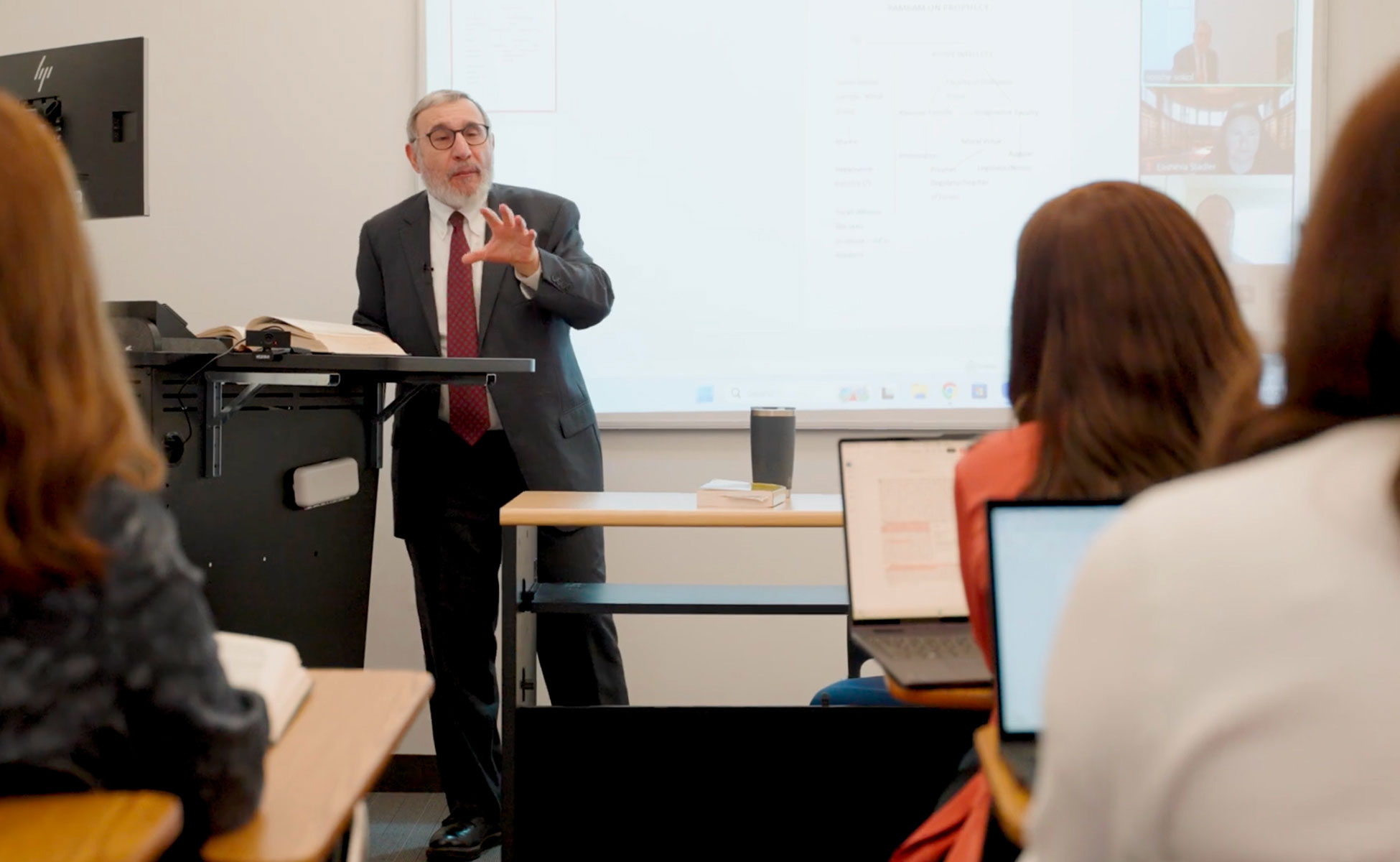
GSJS' Jewish Education track is built around your schedule, your classroom, your passion for Jewish traditions, and your growth as an educator. Whether you’re just starting out or have years in the classroom, you’ll leave the master's program with tools you can use right away.
The Jewish Education track offers separate cohorts for male and female students. It's intentionally designed to deepen your knowledge of Jewish history, texts, and thought while sharpening your teaching methods through hands on practice and expert feedback.
“I taught for several years before I went to graduate school, so Touro didn’t teach me how to teach. But without a doubt, they taught me how to be a much, much better teacher.”
- Rabbi Aharon Friedler, 2021 MA, Jewish Education track; Judaic Studies and AP Computer Science teacher
Your Path to the Degree
The MA in Jewish Studies, Jewish Education track, requires 30 credits with a thesis, or 36 credits with a comprehensive exam. Most students choose the exam.
Your classes will cover Jewish history, curriculum development, research-based teaching methods drawn from general and Judaic sources, and positive and developmental psychology in the classroom. Here's what to expect as you progress toward the degree:
- Foundational courses: effective teaching, classroom management, and curriculum development.
- Subject-area courses: Jewish history and thought.
- Practicum: three to four semesters of supervised teaching with structured, individual feedback.
- Electives: choose areas that match your classroom and school context.
- Culmination: comprehensive exam or, less commonly, a research thesis.
Practicum Spotlight: Feedback that Changes How You Teach
The best teachers are the ones who can’t get enough feedback, says GSJS Jewish education track program director Dr. Shmuel Klammer. That's why he designed a hands-on experience that offers it in abundance.
In the practicum, you’ll teach at least two recorded lessons each semester: one in your Touro classroom and one in a real school setting.
Beforehand, you’ll meet privately with Dr. Klammer to review and refine your lesson plan, drawing on his experience in Jewish school leadership and as dean of Touro College Israel.
After you teach, the class watches the recordings together in an environment that encourages respectful, constructive feedback. You’ll be asked to reflect honestly on your own lesson first, followed by input from your classmates and Dr. Klammer. Alumni also often return as guest presenters, enriching the conversation.
The goal isn’t evaluation, but growth. Dr. Klammer focuses on each teacher’s individual strengths and builds from there, allowing students at every experience level — from brand new teachers to classroom veterans — to develop alongside each other.
Alumni spotlight: Rabbi Benny Berlin, MA ‘17, Jewish Education Track
Rabbi Benny Berlin came to GSJS to deepen his skills as a teacher. He left with something more profound: a new framework for how to think, learn, and lead. He calls it "intelligent compassion."
Today, the young rabbi is an in-demand spiritual leader in the modern Orthodox world. At The BACH Jewish Center in Long Beach, New York, he teaches a daily Talmud class and a weekly Parsha class, preparing for hours before each one.
"People don't want to hear things they already know," he says. Instead, he presents his material at BACH in the way he learned to at GSJS: making sure it's insightful, engaging, and intellectually honest.
Working closely with Dr. Shmuel Klammer, Rabbi Berlin practiced and refined his teaching in real time. They recorded him in the classroom, reviewed the videotaped lessons together, and raised his delivery to match his depth of knowledge.
"I learned a lot of pedagogical tools at Touro," he says. "How to structure a class, how to study, how to engage and retain knowledge, and how to pass that knowledge on by requiring a higher level of thinking. I don't spoon-feed; I give points to ponder."
At BACH, his congregation is growing. But Rabbi Berlin knows that to keep a community engaged, a rabbi must be a teacher in the truest sense of the word. "Without the loving guidance and the level of brilliance of the Touro professors," he says, "I wouldn't have the skills or the open heart to be where I am today."
Course Spotlight: Positive Psychology in the Classroom, Parts 1 and 2
This two-part class asks students to explore a seldom-asked question: What makes a classroom thrive?
Part 1 looks at how positive psychology applies to both teachers and students. Topics include optimism, flow, character strengths, and gratitude, all examined through the latest general research and Judaic sources.
Part 2 focuses on the practical expression of these ideas: how to instill motivation, creativity, and the concept of chidush (novel thinking) from maamarei chazal, into your own classroom environment.
Student Spotlight: Daniella Guterman, MA ‘24, Jewish History Track, GSJS Midcareer Fellow
Daniella Guterman always knew she wanted to teach, but she didn’t expect how much her own learning would shape what happens in her classroom.
“There’s nothing like making children feel loved and cared for while teaching them the importance of living a Torah life,” she says. As an elementary teacher at a Jewish day school on Long Island, she came to GSJS looking to deepen her classroom skills and historical knowledge.
As a midcareer fellow in the master’s program, Daniella learned new approaches she could apply right away. In particular, she credits the positive psychology course with giving her tools to help students face adversity without shutting down. “Teachers need to get our students comfortable with being uncomfortable,” she says, “so they can face challenges with less fear of failing.”
As she’s applied what she’s learning at GSJS in her classroom at HANC (Hebrew Academy of Nassau County), Daniella has seen her students grow more resilient and empathetic. “There’s such great satisfaction when they master or grow in a skill they’ll need for life,” she says. “It’s also incredibly meaningful to see them grow in character.”
Is This Track for You?
The Jewish Education track may be right for you if you:
- Teach or plan to teach in a Jewish day school, yeshiva, or beit midrash.
- Want coaching along with theory.
- Are drawn to the intersection of Jewish learning and educational practice.
- Want to develop as a leader in Jewish education.
- Are a recent graduate or a working educator looking to deepen your skills.
Tuition Discount for Jewish Day School Faculty
Teachers at schools that partner with Touro, are eligible for a 75% tuition reduction.
Contact the Dean’s Office at (212) 463-0400 ext. 55581 or info.gsjs@touro.edu to learn more.
