
Jewish history isn’t just a record of the past. It’s an ongoing discussion about what happened, why it matters, and what we still don’t understand. This program prepares you to take part in that conversation, and to follow your own curiosity toward new lines of inquiry.
“You can't just read an historical text. You have to read, then stop, think, and analyze. When is it written? To whom is it written? What are the circumstances? In every kind of primary source, you have to know how to ask the questions so you can extract the data you need.”
- Dr. Michael Shmidman, Dean Emeritus and Victor J. Selmanowitz Professor of Jewish History
Your Path to the Master’s Degree
In the Jewish History track, you'll take a research methods seminar, to learn how historians find, read, and use different source material. You'll also take two courses surveying the full sweep of Jewish history and thought from the medieval through the modern periods.
As your interests come into focus, you'll work with your faculty advisor to choose seminars that encourage close scholarly work in your area of concentration.
Most classes are offered in person, on Zoom, or both. Over 30 or 36 credits, you’ll:
- Read primary sources critically and place them in historical context.
- Study the full range of Jewish intellectual and cultural history, from medieval to modern.
- Work through the questions that still don’t have answers, with professors who are dedicated to finding them.
- Bring it all together with an original research thesis (chosen by many students) or a comprehensive exam.
Faculty spotlight: Dr. Dana Fishkin, Professor of Medieval Jewish History and Associate Dean
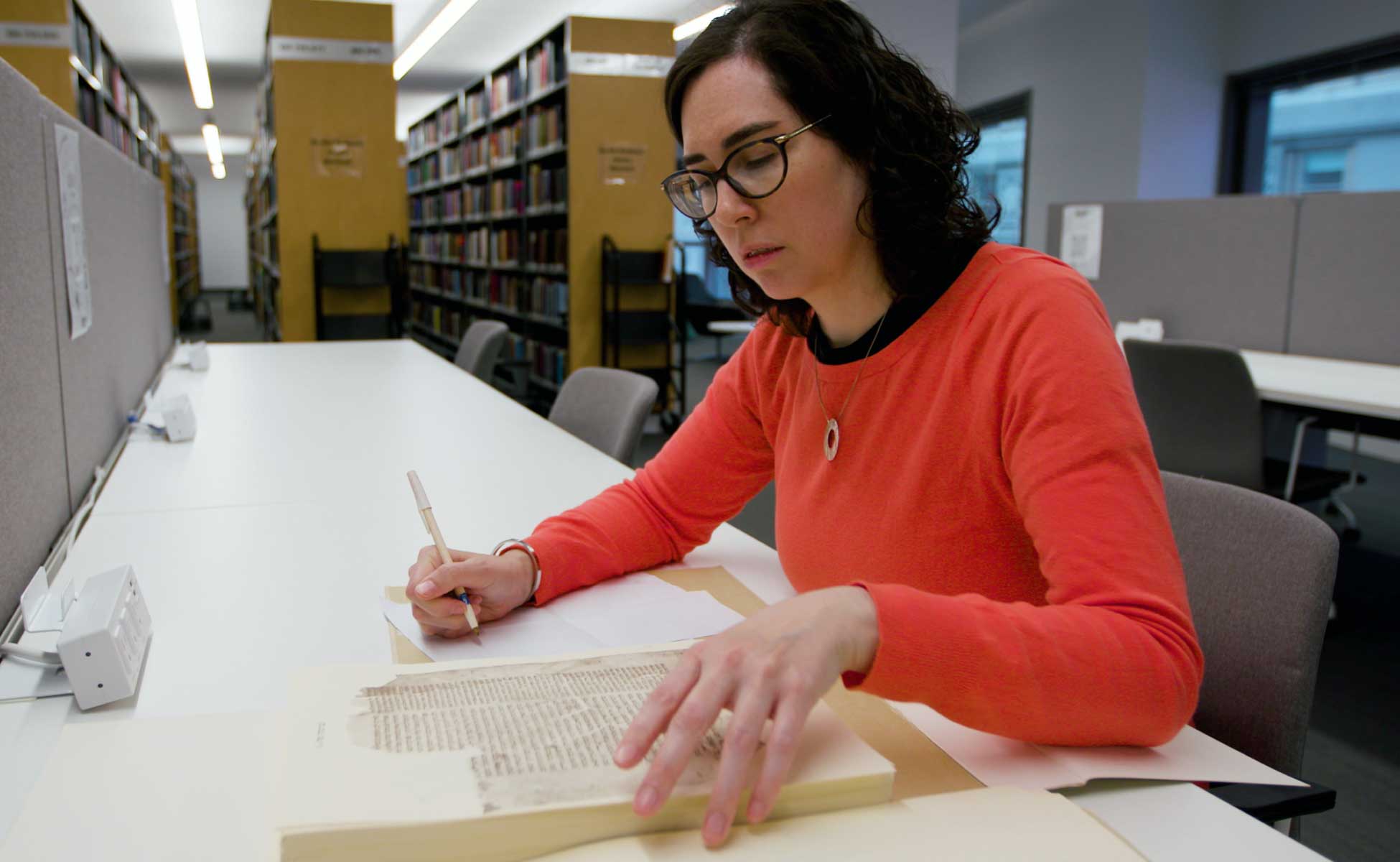
Dana Fishkin studies what many people overlook: the Jews of medieval Italy, a community that lived for centuries at the intersection of Christian and Jewish worlds. When she wrote a book about the 14th-century Jewish Italian poet Emmanuel of Rome, she became the world's foremost expert on the subject. Here's what you need to know to get the joke: "I'm the only person in the world who studies him," she says.
In her classroom, Dr. Fishkin brings fresh perspective to history by treating it as a live debate rather than a settled record. Her signature question: What do we do when two sources contradict each other? When the Jewish account and the non-Jewish record tell completely different stories?
She also has a knack for bringing the past to life in unexpected ways. During COVID, she hired a Roman Jewish tour guide to "walk" students through the neighborhoods Emmanuel of Rome would have known. They took the tour on Zoom, from New York. Dr. Fishkin is now planning an immersive summer course for graduate students on-site in Rome.
Because her enthusiasm is infectious, Dr. Fishkin's classes attract students from all kinds of backgrounds: lawyers, retirees, aspiring academics, career educators — even a park ranger — all in the same seminar. Some come on their path to a degree; others come for the love of learning and keep coming back, sometimes simply to audit her courses.
"It's not this thing where I'm the scholar and I give you information," she says. "I'm empowering you to go out and explore what you're curious about. As much as I'm a teacher to my students, I end up being a student as well."
Course Spotlight: Methods Seminar: Problems and Methods in Modern Jewish Studies
This course is one of the foundations of the master's in Jewish History and reflects GSJS’s conviction that good scholarship starts with curiosity. While most graduate programs expect you to already know how to do historical research, we teach you how by practicing on material that might surprise you.
Working with experienced faculty, you'll learn how historians locate sources, evaluate their reliability, and build an argument from evidence — all by examining records that few have turned to before.
Sources in the class have included medieval ghost stories, and travelogues to hell and heaven. "There are letters, sources from the Cairo Geniza, personal memoirs," says Dr. Fishkin, one of the course instructors. "We look at old maps and new maps and compare them. We look at plague chronicles versus cemetery evidence. And then biblical commentaries and philosophical texts."
It's fascinating what these documents reveal about Jews and their place in society, she adds, because they shine light on a community, a moment, or a set of ideas that no other record has preserved.
Student Spotlight: Rabbi Gidon Shoshan, Midcareer Fellow, MA ‘26
Rabbi Gidon Shoshan has built his career on the belief that the best teacher is often the student. He brings this philosophy to both his work with the global Jewish education organization Olami and to his studies as a midcareer fellow at GSJS.
Raised in Chicago, Rabbi Shoshan earned a B.A. from Touro and spent 12 years teaching at the Jerusalem yeshiva Shapell’s/Darche Noam before joining Olami.
As deputy managing director for English-speaking countries, he now leads programs for Jewish students and young professionals worldwide — sometimes waking at 2:45 a.m. in a Texas hotel room to teach students in Israel.
“None of what I’ve done would have been possible without Touro,” he says. “It has been a key part of my professional and personal life for more than 25 years.”
Rabbi Shoshan also holds an M.Ed. from Harvard University, but returned to Touro to deepen his ability to teach Jewish history. At 47 and as a father of five, he values the flexibility of online learning. “The professors are warm, wise, and knowledgeable,” he says. “They create an environment of curious and intelligent students.”
Original Research in Jewish Studies: GSJS Master’s Theses
A thesis is not required in the Jewish History program, but many students choose to write one as a way to put their research skills and content knowledge into practice. Sample titles include:
- Jews in Chmielnik, 1556–1946: The Rise and Fall of a Polish Jewish Community
- Rabbi Joseph B. Soloveitchik on the Bible
- The Transformation of the London Beit Din under the Leadership of R. Yechezkel Abramsky
- Suffering and Ambivalence in the Writings of Rabbi Ephraim b. Jacob of Bonn
- Novel Continuity: An Analysis of Rav Elyakum Getz’s Rappeduni Be-Tappuhim and its Consonance with Seventeenth-Century Polish Rabbinic Thought
- Divorced From History: Rabbi Asher Hananel and the Sofia Get of 1929
- Theological Shituf in Halakhah: Talmudic, Medieval, and Early-Modern Conceptions
- Rabbi Shimshon Raphael Hirsch’s Approach to Messianism
Alumni spotlight: Chani Gotlieb, MA ‘13, current PhD student
When Chani Gotlieb arrived in New York from Israel on a sabbatical, something shifted within her. A chemist by trade, she stood before the Statue of Liberty and imagined the ancestors who had arrived before her at Ellis Island, immigrating out of desperation yet still daring to hope. In that moment, her ambitions turned toward Jewish history.
Chani stayed in New York and joined the master's degree program at GSJS. In the Jewish History track, she gained not just content knowledge, but a new way of seeing. "I learned to identify myths woven into the historical narrative and to corroborate personal accounts with reputable sources," she says, "Touro took me from an amateur to a professional Jewish historian."
She now brings the same care for evidence to her role teaching Jewish history at Manhattan High School for Girls. Instead of lecturing, Chani developed a genealogy project for her students. They conduct interviews with their oldest family members — including some Holocaust survivors who had never spoken out before — to be documented, published, and shared.
In this way, Chani says, she teaches students to think like historians: "focusing on ideas, trends, culture, and always highlighting human nature and the patterns that repeat themselves, because human nature doesn't change."
Is the Jewish History Track Right for You?
The Jewish History track master's degree might be right for you if:
- You have a deep interest in Jewish history and thought and want to study it seriously.
- Teach Jewish history or Judaic studies and want stronger research skills.
- Are a lifelong learner who wants a rigorous, structured course of study.
- Are considering a doctoral program and want strong preparation.
