
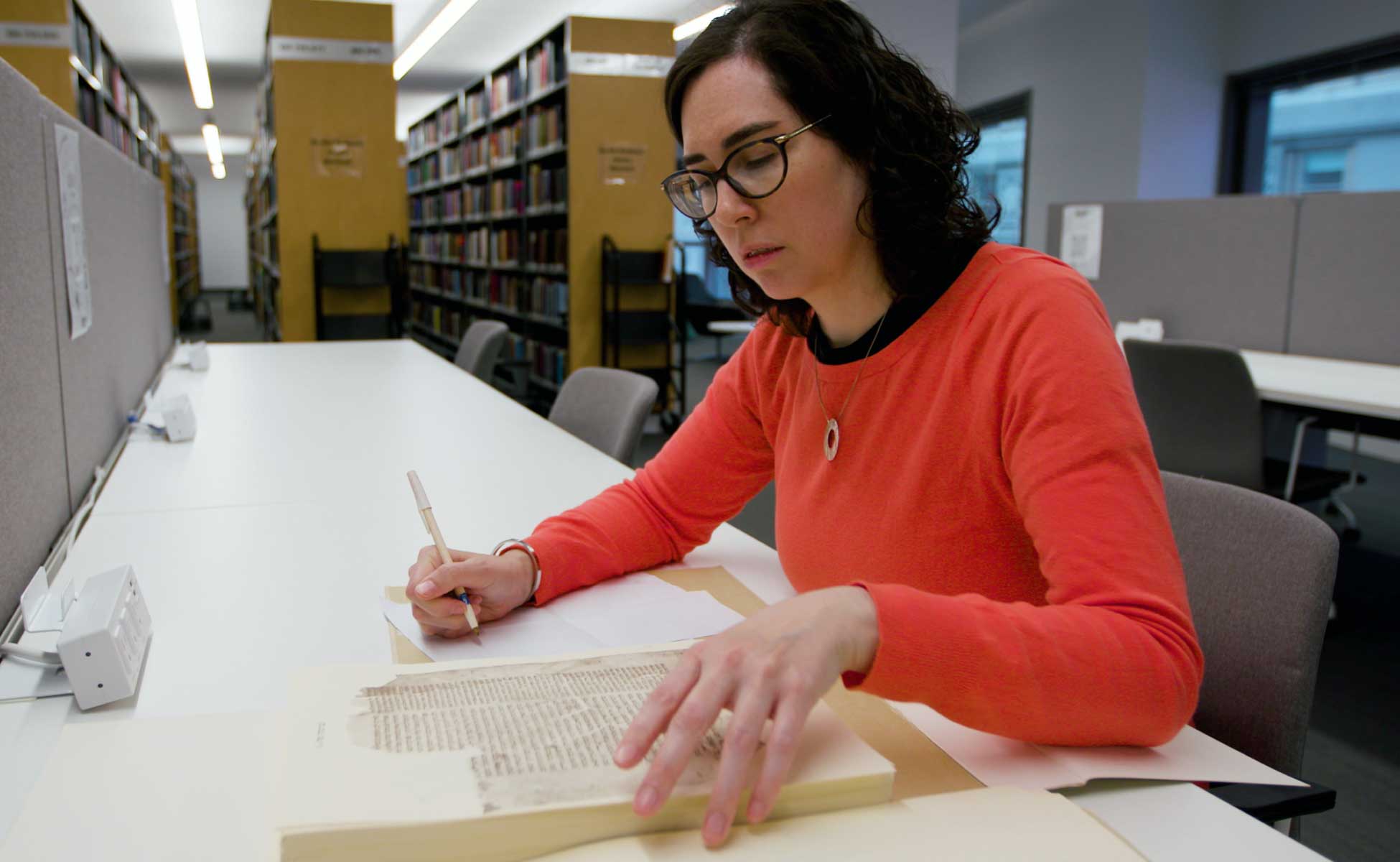
The MA in Jewish Studies, Jewish History track, is designed to give you mastery of a specific area of Jewish history. The program runs 30 or 36 credits depending on whether you choose the thesis track. It includes three or four required core concentration courses (9-12 credits).
Thesis Track
Recommended for students seeking to continue their studies toward a doctoral degree, the requirements for the thesis track are:
- A minimum of 30 credits of approved graduate coursework.
- 24 of the 30 credits must be in your area of specialization, and 12 of the credits will be core concentration courses. Note: there will be overlap with courses that can count as both a core course and a course in your area of specialization.
- Submission and approval of a master’s thesis.
Non-Thesis Track
Recommended for those who do not plan to pursue a degree beyond a master’s, non-thesis track requirements are:
- A minimum of 36 credits of approved graduate coursework.
- 24 of the 36 credits must be in your area of specialization, and 9 of the credits will be core concentration courses. Note: there will be overlap as a core course could also be in your area of specialization.
- Successful completion of a written comprehensive examination in the area of specialization.
Core Concentration Courses
- A two-course sequence (HJGN 600 Medieval & HJGN 601 Modern) examining Jewish literature, culture, and history of the medieval and modern periods (3 credits each course).
- A methodological seminar (HJGN 670) on the use of historical sources of the medieval and modern periods (3 credits).
- An advanced research seminar (HJGN 672) leading toward the thesis (for thesis-track students only).
Elective Courses
You may choose from a wide variety of electives in both your area of specialization and related disciplines. Emphasis is placed on your ability to analyze texts and source materials of the period.
Course List
HJGN 600 - History of the Jews in the Middle Ages (Annual) (3 credits)
Social, economic, political. and intellectual history of medieval Jews, particularly in the major European centers. Emphasis is placed on developments in law, philosophy, poetry and mysticism. Topics include: the status of Jews under Christianity and Islam; communal organization and economic activity; Jews in European culture; Jewish-Christian polemics; controversy regarding the study of philosophy; crusades and martyrdom; expulsion, Marranism; Sabbatianism; and transition to the modern period.
HJGN 601 - History of the Jews in Modern Times (Annual) (3 credits)
A survey of modern Jewish history from the French Revolution to World War 1. Major developments are analyzed in light of political, social and ideological currents and trends. Emphasis is placed upon the emergence of diverse expressions of Jewish religious and secular identity. Topics include: the Enlightenment and emancipation; Wissenschaft des Judentums; rise of Reform Judaism; the Positive-Historical School: Neo-Orthodoxy; eastern Haskalah; Volozhin and the Yeshiva movement; Mussar movement; Jewish socialism; political and racial anti-Semitism; migrations; Hibbat Zion and Zionism.
HJGN 602 - History of the Geonim and their Yeshivot (Upon Request) (3 credits)
The Babylonian Jewish community and its institutions from the beginning of the Geonic era until the passing of Rav Hai (1038). The Geonim as successors of the Amoraim, as arch champions of the Babylonian Talmud and as predecessors of the Rishonim in Europe.
HJGN 605 - Early Rabbinic Literature: The Mishnah (Biennial) (3 credits)
History, content, structure and methodology of the Mishnah and related Tannaitic literature.
HJGN 606 - The Non-Jew in Rabbinic Literature (Biennial) (3 credits)
The gentile or non-Jew has played a prominent role in rabbinic literature from the time of the Mishnah or late antiquity until the present day. This course will explore this literature, showing how the Jew interacted with the gentile both socially and halakhically, with each new social reality throughout Jewish history offering new challenges and requiring the rabbis to find new solutions.
HJGN 607 - Development of Post-Talmudic Literature (Upon Request) (3 credits)
An examination of Jewish legal literature from the close of the Talmud until the 14th century. The course will analyze the authorship, content and methodology of specific works, and assess the purpose of these works. Readings will include: R. Hai Gaon, R. Yitzchak Alfasi, R. Yonatan m’Lunel, Rashi, Ri Migash, Maimonides, Nahmanides, Rashba and Ritvah.
HJGN 609 - History of the Rabbinate in the Middle Ages (3 credits)
A study of the emergence of an ordained, professional rabbinate in the Middle Ages. Topics include: sources related to the institution of rabbinic ordination; the 16th century semikha controversy; rabbis as educators; the rabbinate in Sephardic and Ashkenazic communities.
HJGN 610 - Ashkenazic Jewry in the Middle Ages (Biennial) (3 credits)
A study of the political status, economic foundations, communal organization. family structure, educational ideals and reality as well as the intellectual activities of Ashkenazic Jewry in the Middle Ages. Emphasis placed on the primary sources of the period.
HJGN 612 - Italy: Conduit of Medieval Jewish Culture (Biennial) (3 credits)
A study of the sources of Italian Jewish history highlighting Italian Jewry's role as a transmitter of Jewish culture and its characteristic blend of materials and forms. Topics include: the beginning of Italian Jewish civilization and the varieties of Italian Jewish literary creativity during the early and late Renaissance, with attention paid to such figures as Anatoli, Recanati, Shibbolei Haleket and Azariah de Rossi.
HJGN 613 - Jews in the Renaissance (Biennial) (3 credits)
Religious, cultural, social, and political history of the Jews in Italy from the 13th-17th centuries.
HJGN 615 - The Church and the Jews (Upon Request) (3 credits)
This course will examine the range of Christian attitudes to Jews and Judaism over the centuries, from the first century to our own time. It will focus on major events and themes. These include the foundational teachings of Paul and the Church Fathers; the growth of the Western Church; the First Crusades; forced disputations; late medieval demonization of the Jews; the impact of the Protestant and Catholic Reformations; the emergence of the ideas of tolerance; and the issuing of "Nostra Aetate" (Vatican II).
HJGN 616 - The War Against the Talmud (Biennial) (3 credits)
Christian attitudes toward the Talmud in the medieval and modern periods: burnings, censorship and academic study.
HJGN 617 - Kiddush Hashem in Jewish History and Thought (Biennial) (3 credits)
This course examines the evolution of the concept of Jewish Martyrdom, from its Biblical roots until the Holocaust. Based primarily upon close reading of primary sources, students will follow the manner in which changing circumstances and challenges affected and fashioned the legal and extra-legal modes of martyric conduct. These will be examined in light of discrete analyses of specific historical events: The Babylonian Exile (586-536 BCE), The Antiochine Persecutions (167 BCE), The Great Revolt Against Rome (66-73 CE), The Hadrianic Persecutions (130-135 CE), The First Crusade (1096 CE), The Spanish Persecutions (1391 CE), The Chmielnicki Revolt (1648-1649 CE), the Holocaust (1933-1945 CE).
HJGN 618 - The Controversy Over the Study of Philosophy in the Thirteenth and Fourteenth Centuries (Biennial) (3 credits)
An examination of the controversy in Spain and Provence, exploring the varied positions of proponents and opponents of Maimonides' writings, and the roles of Rashba and Hameiri.
HJGN 619 - The Jews of Early Modern Europe (Annual) (3 credits)
This course will deal with a period of major transformation in European Jewish life, from 1492 to 1750. It will focus on changes in Jewish-Christian relations, the impact of modern state-building on Jewish existence, and currents in Jewish thought and social life. Throughout, it will entail an examination of different patterns of development within Sephardi, Ashkenazi, and Italianate Jewish communities, as well as the interaction between members of these sub-groups.
HJGN 620 - History of the Conversos in Spain and Portugal (Upon Request) (3 credits)
This course focuses on the key dynamics of change within the population of Conversos from Spain and Portugal over the course of three hundred years, from 1391 to the end of the seventeenth century. The course will consider major controversies among scholars regarding who the Conversos \'really\' were, and examine the creation of a diaspora of ex-conversos who rejoined, or established Jewish communities outside Iberian lands.
HJGN 623 - Jews in the Muslim World: 15th - 20th Centuries (Annual) (3 credits)
A survey of the history of Jewish communities in Muslim societies and under Muslim rule, from the conquests of the 15th century to the dispersions and transformations of the 20th century. Including: Social, political, economic and legal developments; Demographic trends; Interactions between communities; Impacts of Imerialism, Nationalism and modern State-Building.
HJGN 624 - The Holocaust and Jewish Law (3 credits)
This course explores the interplay between the Holocaust and Jewish law (Halakha), examining rabbinic responses to unprecedented moral, legal, and theological challenges during and after the Shoah. Students will analyze case studies, responsa literature, and scholarly perspectives to understand how Jewish law confronted questions of survival, faith, and justice.
HJGN 625 - Diasporas, Networks and Urban Centers in the Jewish World from the 15th to the 20th Centuries (Biennial) (3 credits)
A review of new analytical and methodological strategies and approaches employed in the study of Jewish history, diverging from single national narratives, local or regional focus, and monolithic models of community structure and development.
HJGN 628 - Maimonidean Texts on Messianism (3 credits)
A close study of Maimonidean texts dealing with the nature of the Messiah, the Messianic Age, the World-to-Come and Resurrection of the Dead.
HJGN 629 - Religious Responses to Modernity (3 credits)
This course will examine the responses of several leading rabbinic figures of the 19th and 20th centuries to the social and cultural changes wrought by modernity, specifically, either the incorporation of previously self-contained autonomous Jewish communities into the political and civic life of the states in which they developed, or communities that developed in the State of Israel. Three key issues will be stressed: the value of modern culture; the legitimacy of the notion of historical progress (scientific and ethical); and the extent to which Judaism is a truly universalist system which incorporates the welfare of every human being in the purview of its religious concerns and historical vision. Each thinker's conceptualization of halakhah will be examined. Thinkers include: Rabbis S. R. Hirsch, Zvi Hirsch Chajes, Elijah Benamozegh; Rabbis Yehiel Yaakov Weinberg, Eliezer Berkovits, Nachum Rabinovitch, Jonathan Sacks.
HJGN 630 - Messianic Ideas and Movements (Biennial) (3 credits)
Survey of messianic ideas and movements in Jewish history, with emphasis on medieval developments and their significance. Topics include: messianic movements under Islam; messianism in medieval Jewish philosophy, especially the writings of Maimonides; the impact of the Spanish expulsion; David Reubeni and Solomon Molkho; Lurianic Kabbalah; Sabbatianism and Hasidism.
HJGN 631 - Poland, the Holocaust and the Jews (Biennial) (3 credits)
Polish-Jewish relations before, during and after the Holocaust.
HJGN 632 - Readings in Jewish Historical Literature: From the Second Temple Period to the Spanish Inquisition (Biennial) (3 credits)
A study of Jewish historical writing from the Second Temple period to the Spanish expulsion in 1492. Readings include the Letter of Aristeas, Josephus, Iggeret Rav Sherira Gaon, Sefer Josippon, Sefer ha-Kabbalah, Crusade Chronicles and writings of the Spanish Inquisition. Attention is paid to the question of medieval Jewish attitudes toward the study and meaning of history.
HJGN 633 - Readings in Jewish Historical Literature: From the Sixteenth Century to the Modern Period (Biennial) (3 credits)
A study of Jewish historical writing from the works of sixteenth century authors including Solomon ibn Verga, Joseph ha-Kohen, Samuel Usque and Azariah de Rossi, to the diary of Gluckel of Hameln and Nathan Hannover’s Yeven Metzulah, to the writings of the Wissenschaft des Judenthum in the nineteenth century.
HJGN 634 - History of the Jews in Eastern Europe, 1772-1917 (Biennial) (3 credits)
A survey of the social, political, religious, and intellectual history of the Jews in Russia and Poland from the partitions of Poland to the Russian Revolution. Topics include: the legacy of the Polish commonwealth; Hasidism and traditional Jewish society; Jews in Russia, Galicia, Congress Poland and Posen; Alexander II, the great reforms and the flourishing of Haskalah; emancipation in Poland, Austria and Prussia; social and economic transformations; the rise of Jewish nationalism; socialist, autonomist, and revolutionary ideologies; beginnings of migration; Hebrew and Yiddish literature; traditional Jewish life and the emergence of an orthodoxy; constitution, war, and revolution.
HJGN 635 - History of Hasidism (Biennial) (3 credits)
An examination of the social, economic and religious context which gave rise to Hasidism. The course will include: an analysis of the tales related to the Baal Shem Tov and disciples of the Besht; a study of the formation of a Hasidic movement; Mitnagid opposition to Hasidism; Hasidic customs and fundamental ideas of Hasidism, including the Zaddik and Devekut.
HJGN 636 - Reform and Counter-Reform (Annual) (3 credits)
A detailed examination based on original sources of the theological, halakhic, and social issues which shaped the early reform movement in Germany, Hungary, England and the United States; Orthodox reaction and response as mirrored in periodical and responsa literature; internal development and transformation of attitudes within the reform movement; contemporary trends.
HJGN 637 - Jewish Historical Scholarship in Poland: 1918-1939 (Biennial) (3 credits)
An examination of the various ways in which a sense of national mission shaped the intellectual contours of Jewish historical scholarship in interwar Poland. The course focuses upon the writings of Schipper, Schorr, Balaban, Mahler, Friedman and Ringelblum.
HJGN 638 - The Holocaust (Annual) (3 credits)
A seminar on the destruction of European Jewry during the years 1939-1945. Topics include: antisemitic and racist antecedents; the rise of the Nazi dictatorship; implementation of the "Final Solution”; Jewish responses to the catastrophe; reactions to Nazism in the free world, and post-World War II legacies.
HJGN 639 - History of Anti-Semitism (Biennial) (3 credits)
An examination and analysis of the historical and cultural roots of antisemitism from ancient times until the present, concentrating on religious, sociological, economic and philosophical expressions.
HJGN 640 - The Rise of Modern Israel (Annual) (3 credits)
The emergence of Zionism during the years 1880-1948 is examined with an emphasis on the major ideologues of the movement and factors which ultimately led to the creation of the State of Israel.
HJGN 641 - Zionism and Non-Zionism: Attitudes of Jewish Religious Thinkers (Biennial) (3 credits)
The study of the attitudes and responses of Orthodox and Reform thinkers to the rise in political Zionism in the late 19th and 20th centuries.
HJGN 642 - Israel and the International Protection of Human Rights (Annual) (3 credits)
The seminar will address the development of international human rights law and politics from the end of the Holocaust until today. Our focal point will be the application and impact of these developments on the state of Israel. Particular attention will be paid to the United Nations system. The course will include a visit to one or more UN meetings.
HJGN 643 - Rescue Efforts During the Holocaust (Biennial) (3 credits)
The course will examine some of the major efforts of communal and religious leaders to save Jews during World War II.
HJGN 644 - The Holocaust through the Lens of Documentary Films (Biennial) (3 credits)
A study of cinematic treatments of the Holocaust and its public memory and representation.
HJGN 645 - Jewish Life in Europe after the Holocaust: Community and Memory (Annual) (3 credits)
This course will examine Jewish experiences in postwar Europe, exploring social, religious, and cultural issues confronting survivors as they attempted to rebuild their personal lives and communal institutions in Eastern and Central Europe and in the DP camps.
HJGN 646 - Jewish Communities of the World (Annual) (3 credits)
An exploration of the cultural, social, political and religious character and needs of Jewish communities, large and small, throughout the world, in light of their individual histories.
HJGN 647 - Varieties of Jewish Memoir Literature: From the Late Middle Ages to the Modern Period (Biennial) (3 credits)
The course explores different forms of Jewish self-writing from the middle ages to the modern period. We will read letters, diaries and autobiographical texts from both Western and Eastern Europe. The Jewish works will be analyzed within their wider social and cultural context. Readings include letters of Rabbi Yom Tov Lippman Heller, the autobiography of Leon of Modena, writings of 16th century mystics, diaries of R. Chaim Yoseph David Azulai and Rabbi Moshe Sofer.
HJGN 648 - Literature of Modern Jewish History (Biennial) (3 credits)
A survey of a range of memoirs, diaries and letters pertaining to the development of American Jewish life, during the 19th and early 20th centuries.
HJGN 649 - The Holocaust and Local Jewish Communities (Biennial) (3 credits)
Major Jewish communities of eastern Europe (e.g., Warsaw, Lodz) until their destruction in the Holocaust.
HJGN 650 - Holocaust: Special Issues Relating to Rescue Possibilities (Biennial) (3 credits)
Topics in this seminar include: Could more Jews have been saved by the Allies?; Negotiations with the Nazis; The Holocaust and Halacha and Nazi definitions of Jews: Mischlinge, Baptized Jews, Karaites (Poland), Spanish Jews (Holland), Mountain Jews (Caucasia), Persian Jews (France).
HJGN 651 - The Israel-Arab Conflict: From the Late Ottoman Period to the Present (Biennial) (3 credits)
Seminar on the Israel-Arab conflict from its pre-Israel origins, beginning with the late Ottoman period, followed with the British Mandate; the UN decision, the Israel-Arab wars and failed peace negotiations, culminating in the Sadat visit and the current climate.
HJGN 652 - American Jewry in the Twenty-First Century (Biennial) (3 credits)
Seminar on the American Jewish experience from the East European migration to the present. Topics include: acculturation; novel forms of communal life; assimilation; the growth of American Zionism; non-Jewish perspectives, and contemporary issues of concern.
HJGN 653 - Rabbi S. R. Hirsch: Life and Thought (Biennial) (3 credits)
This course will examine the life and thought of Rabbi S. R. Hirsch (1808-1888), as well as his major works. The historical context for R. Hirsch’s life work, including the European Enlightenment, the Haskalah, and the German-Jewish Reform movement, will be examined.
His worldview, which includes his all-encompassing Torah im Derekh Eretz ideology, Mensch-Yisroel (relating to human and Jewish identity), and Austritt (communal separatism/secession), among others, will be treated in this class. Comparisons to the views of his rabbinic predecessors and contemporaries both in Germany and elsewhere will also be explored.
R. Hirsch’s accomplishments as a Jewish leader will be analyzed and his legacy for contemporary Judaism—and his relationship to varieties of Orthodox Judaism of the twenty-first century—will be explored.
HJGN 654 - Religious Issues in American Jewry (Biennial) (3 credits)
An examination of religious matters in American Jewish life from colonial times to the present, reflected in responsa, periodical literature and other primary sources. Issues will include: religious Reform and Orthodox responses to Reform; attitudes to the Zionist movement; Conservative / Reconstructionist Judaism; Modern Orthodoxy; Hasidism and the "Yeshiva world" in post-war America.
HJGN 655 - Jews and Modern Media (Biennial) (3 credits)
Jews and Media Media explores the specific mediums of communication as technological innovations and how they were used to affect Jewish life in changing cultural, political, religious, and economic conditions.
HJGN 656 - Seeking Justice after the Holocaust: The Trials of Nazi War Criminals and their Collaborators (Biennial) (3 credits)
This course will examine the ways in which the legal systems in Europe and in Israel struggled with and sought justice for the victims of the Nazi crimes after the Second World War. Topics will include the Nuremberg trials in postwar Germany and the Eichmann trial in Israel.
HJGN 657 - Writing Local Jewish History: Theory and Practice (Biennial) (3 credits)
The course offers a hands-on exploration of local history as it is practiced and conceived in the Jewish context. It will examine the methods used in studying local history and engage students in researching the history of Jewish communities.
HJGN 658 - Jewish Law Codes of the 19th Century (Biennial) (3 credits)
Close examination of the Arukh Ha-Shulhan, Mishnah Berurah and Hayei Adam in the contexts of the history of the genre and the social and communal realities of the period.
HJGN 659 - Negotiations with Nazi Germany for the Rescue of Jews (Biennial) (3 credits)
Exploration of attempts by Jewish and non-Jewish sources to negotiate with the Nazi Germany regime for the rescue of Jews prior to and during the war years.
HJGN 660 - Topics in Jewish History (Annual) (3 credits)
An analysis of currents in medieval and modern Jewish history through readings of selected texts. Sample topics: Jews in the Muslim World: 15th-20th Centuries; Diasporas, Networks and Urban Centers in the Jewish World from the 15th to the 20th Centuries; The Art of the Other: Jews in Medieval and Modern European Art; Jews and Art; The War Against the Talmud; Jewish Autobiographies in 19th and 20th Century Eastern Europe; The Holocaust through the Lens of Documentary Films; Holocaust and Halakhah; Historiography of the Holocaust; French Jewry, 1806-1905; Religion and State: Israel - A Case Study.
HJGN 661 - Aggadah and its Medieval Commentators (Biennial) (3 credits)
The attitude of Rishonim toward aggadot Hazal, how the commentators distinguished among various types of aggadot, and how they put their theory into practice in the form of commentary on the aggadot. Among the Rishonim whose views and approaches will be studied are R. Abraham ibn Ezra, Rambam, Ramban, Rashba, and R. Menahem Hame\'iri. Special emphasis on the place that aggadah and its interpretation occupied in the world outlook of halakhists, philosophers, and kabbalists in the Middle Ages.
HJGN 662 - Abot Commentaries as a Source of Jewish History (Upon Request) (3 credits)
Studies in the history of interpretation of passages in tractate Abot, as barometers of trends and developments in Jewish intellectual and social history.
HJGN 663 - Topics in the History of Halakhah (Annual) (3 credits)
Text-based analysis of topics related to the development and literature of halakhah, with emphasis upon the medieval and modern periods. Sample topics include: History of Prayer; Methodologies of Arukh Ha-Shulchan and Mishnah Berurah; Halakhic Literature of the Sixteenth Century; Pluralism and its Limits in Jewish Legal Theory.
HJGN 665 - From Synopsis to Code: A History of Halakhic Literature (Biennial) (3 credits)
A history of the medieval halakhic literature from Geonic times: methods and styles of codification and Talmudic exegesis, literary style and influences, genres and their spread.
HJGN 666 - History of Jewish Ethical Literature (Upon Request) (3 credits)
A survey of Jewish ethical writings from post-talmudic to modern times. Authors studied include Maimonides, R. Bahya ibn Pakuda, R. Judah the Pious, R. Jonah Gerondi, R. Moses Luzzatto, and R. Israel Salanter. Emphasis is placed on the role of ethical literature in Jewish intellectual history.
HJGN 667 - History of Minhagim (Biennial) (Upon Request) (3 credits)
This course will examine the historical and social development of minhag within the body of rabbinic literature. We will investigate the place and status of minhag in halakhah as well as its role as a historical source of law. The analysis will focus on such principles as minhag mivatel halakhah, minhag Yisrael din and minhag avotenu biyadenu. Illustrative examples of specific customs will be explored, including minhagim such as mourning rites during sefirat haomer, the times when women are exempt from work, kapparot, beards, and customs related to the holiday of Shavuot, bar and bat mitzvah and Sefer Torah.
HJGN 668 - Individual Reading and Research (Annual) (credits by arrangement)
Credits by arrangement.
HJGN 669 - The Boundaries of Halakhah: Halakhah and Aggadah, Halakhah and Kabbalah (Biennial) (3 credits)
How different Rishonim and Aharonim view the dividing line between “Halakhah" on the one hand and “Aggadah” on the other; different approaches to the incorporation of Kabbalah into Halakhah.
HJGN 670 - Methods Seminar: Problems and Methods in Modern Jewish Studies (Annual) (3 credits)
Close analysis of texts, with emphasis on proper utilization of primary source material, general and specific methodological problems in the study of Jewish history, currents in recent scholarship, and practical use of bibliographical and research aids.
HJGN 671 - Halakhah, Philosophy and Mysticism: Interactions and Tensions (3 credits)
Traditional Judaism comprehends two disparate elements: Law and Sprituality. These recalcitrant movements complement and invigorate one another. While, in the pre-modern world, the Legal component of Judaism was both stable and consistent, its sources of spiritual inspiration were broadly divided between Rationalism and Mysticism. These, in turn, sought to infuse observance of the Law with both meaning and telos. The result was an ongoing tension between them, whenever ideological aims diverged from the formal upshot of Legal analysis. This course examines and characterizes the interactions between Law and different schools of Philosophy and Mysticism, in the medieval era (850-1650 CE). Among the issues addressed are: The Halakhic Process, The Role of Axiological Factors in Halakhic Decision-making, the Character of Jewish Philosophy (Kalamist, Neo-Platonic and Aristotelian), Philosophy and Law, the Search for Reasons for the Commandments, The Nature of the Mystical Search, The Law as a Divine Emanation and its Impact on the Commandments, The Lurianic Revolution and its Impact.
HJGN 672 - Research Seminar (Annual) (3 credits)
Students pursue guided research into the sources of Jewish history and formally present the results of their investigations in class for discussion and critical evaluation.
HJGN 674 - Premodern Demons and Monsters: The Supernatural as a Lens into Jewish Social and Cultural History (Biennial) (3 credits)
This seminar examines the rich and largely understudied world of demons, monsters, and supernatural beings in premodern Jewish culture as a window into broader questions of social organization, religious authority, gender, medicine, and intercultural exchange. Drawing on a wide range of primary sources — including Talmudic literature, medieval legal texts, mystical and kabbalistic writings, amulets, folktales, and visual culture — students will interrogate how Jewish communities across time and geography imagined, classified, and responded to supernatural threats. Special attention will be given to the methodological challenges of reading these sources historically: what does a demonological text reveal about the anxieties, power structures, and cultural negotiations of the community that produced it? The course situates Jewish supernatural culture in comparative perspective, exploring points of contact and tension with Christian and Islamic traditions in medieval Europe and the Near East. By the end of the seminar, students will have developed a sophisticated set of tools for reading premodern sources against the grain, treating the fantastical not as marginal curiosity but as a serious and revealing archive of Jewish historical experience.
HJGN 675 - The Holocaust in the USSR (3 credits)
The Holocaust in the Soviet Union included diverse experiences of persecution, resistance, displacement, and survival. Topics include prewar Jewish life, the German invasion, the Einsatzgruppen and mass shootings, Jewish resistance and partisans, evacuation and survival in Central Asia, gendered violence, and Soviet Jewish prisoners of war. The course also addresses liberation, postwar antisemitism, testimony, commemoration, and Holocaust memory in the Soviet and post-Soviet periods.
HJGN 676 - Jews in the Russian Empire and Eurasia (3 credits)
This course examines Jewish life in the Russian Empire, Soviet Union, and post-Soviet Eurasia from 1881 to the present. Topics include pogroms and migration, Zionism and revolutionary movements, Soviet nationalities policy, Stalinism and antisemitism, Jewish experiences during World War II, postwar repression, the refusenik movement, and Jewish life in Central Asia and the Caucasus. The course concludes with Jewish communal revival, migration, and antisemitism in post-Soviet Eurasia.
PJSN 600 - Religion and Philosophy in Medieval Judaism (Biennial) (3 credits)
Study of the framework and basic concerns of medieval Jewish thought as expressed in the works of R. Saadiah Gaon, R. Bahya ibn Pakuda, R. Judah Halevi, Maimonides, and R. Joseph Albo. Themes include: faith and reason, prophecy, miracles, free will, dogma, reasons for the commandments, ethics, and prayer. Differing attitudes toward the value of philosophy will be analyzed, and attention paid to relevant writings of Islamic and Christian thinkers.
PJSN 602 - Modern Jewish Philosophy (Upon Request) (3 credits)
Study of the framework and basic concerns of modern Jewish philosophy as developed in the works of such thinkers as Franz Rosenzweig, Emil Fackenheim, A.J. Heschel and Rabbi Joseph B. Soloveitchik. Themes include: the human-divine relationship, philosophy of halakhah and mitzvot, covenant, faith, post-holocaust theology and Jewish peoplehood.
PJSN 615 - Reasons for the Commandments in Medieval Jewish Thought (Biennial) (3 credits)
This course will survey the variety of approaches to ta’amei ha-mitzvot by Jewish thinkers from the 9th through the 16th centuries. Among the rabbinic positions discussed will be those of: R. Saadya Gaon, R. Bahya ibn Pakuda, Maimonides, R. Judah Halevi, R. Hasdai Crescas, Nahmanides, and the Maharal of Prague.
PJSN 617 - Philosophy of the Maharal (Upon Request) (3 credits)
Text-based study of the thought of Maharal of Prague and the influence of his work.
PJSN 618 - The Divine Will in Jewish Tradition (Biennial) (Upon Request) (3 credits)
This course focuses on depictions of the divine will in Jewish texts throughout the generations. It considers the nature of the divine will, its role in creation, how the divine will both complicate and simplifies the problem of evil, its relationship to Halakhah, and the question of how much room it leaves for human free will. Primary texts to be studied include biblical and Second Temple texts (Dead Sea Scrolls, Philo) and sources from Hazal; a variety of medieval philosophical texts; kabbalistic works and Hasidic texts; and various other modern and contemporary perspectives.
PJSN 620 - The Problem of Evil in Jewish Thought (Upon Request) (3 credits)
This text-based course examines the approaches of a select group of medieval and modern Jewish thinkers to the classical problem of theodicy: How can a good Gd allow for the evil and suffering that human beings experience in the world? Readings will be drawn from Saadya Gaon, Maimonides, the Zohar, and the writings of R. Joseph B. Soloveitchik and R. Eliezer Berkowitz.
PJSN 630 - Jewish Ethics (Upon Request) (3 credits)
A survey of major themes in the treatment of ethical issues as found in Jewish sources. Topics include the autonomy of ethics, the relationship of halakhah to ethics, supererogatory behavior, imitatio dei, Jewish models of moral perfection, and applied moral problems such as lifeboat ethics, capital punishment and war. Emphasis is placed on the methodology of Jewish ethics as a discipline, and on close reading of sources, which include selections from biblical, talmudic, midrashic, halakhic, philosophic and ethical works.
PJSN 660 - Topics in Jewish Philosophy (Annual) (3 credits)
Analysis of a selected topic in medieval or modern Jewish philosophy through readings of primary sources. Sample topics include: Nature and Miracle in Medieval Jewish Philosophy; Simple Faith and Sophisticated Faith: Rabbi Saadiah Gaon and Rabbi Moses Taku; The Writings of Rabbi Joseph Soloveitchik.
BJSN 602 - Medieval Biblical Exegesis (Annual) (3 credits)
A systematic and comparative study of the exegetical methods of medieval Jewish Bible commentators, including Rashi, Rashbam, Ibn Ezra, Radak, Nahmanides, and Gersonides. Attention is paid to exegesis as a mirror of intellectual history.
BJSN 603 - Studies in Sixteenth-Eighteenth Century Biblical Commentaries (Biennial) (3 credits)
A systematic, comparative study of the exegetical methods of Abarbanel, Sforno, Rabbi Hayyim ibn Attar and Rabbi Elijah Gaon of Vilna.
BJSN 604 - Studies in Nineteenth-Twentieth Century Biblical Commentaries (Biennial) (3 credits)
A systematic, comparative study of the exegetical methods of R. Kalonymus Kalman Epstein, Malbim, R. Jacob Zevi Meklenburg, Neziv, R. David Zevi Hoffman and R. Meir Simcha ha-Kohen.
BJSN 605 - Philosophical Biblical commentaries in the Middle Ages (3 credits)
This graduate seminar examines the development of rationalist and philosophical approaches to Jewish textual interpretation in the Middle Ages. Focusing particularly on medieval commentaries on Ecclesiastes, Song of Songs, Proverbs, and Job, the course explores how Jewish scholars employed philosophy, science, and linguistic analysis to interpret biblical wisdom literature and negotiate the relationship between reason and revelation.
BJSN 610 - Chronology and Context in Medieval Biblical Exegesis (Upon Request) (3 credits)
An examination of issues concerning the chronological order of Biblical events and the juxtaposition of sections in the Torah, as analyzed by medieval Biblical exegetes. Attention to differences in emphasis and approach between midrashic literature and medieval commentaries.
